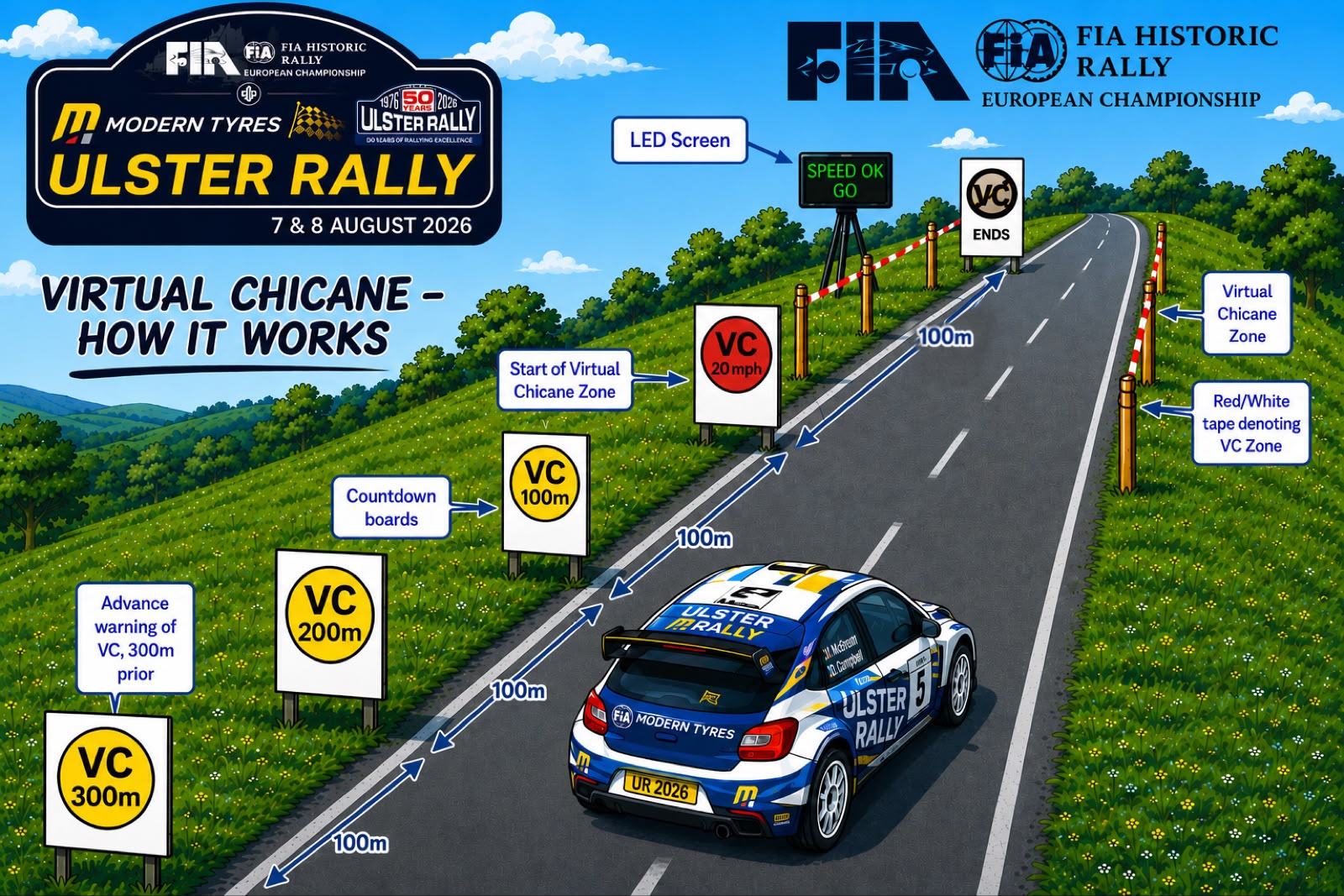
The Modern Tyres Ulster Rally will be introducing Virtual Chicanes as a safety measure to reduce vehicle speeds at designated locations alongside some physical chicanes on the 2026 route.
The approach to each Virtual Chicane will be clearly marked by yellow VC countdown boards positioned at 300 metres, 200 metres and 100 metres before the control zone. The Virtual Chicane Zone begins at a red “VC Start” board and will extend for 100 metres, ending at a beige “End of Control” board.
Within this 100-metre zone, competitors must reduce their speed to the required target of 20 mph at some point before leaving the control area. Crews may begin braking before the start of the zone, but the required speed must be achieved within the limits of the Virtual Chicane.
The system operates in a similar manner to a forward-facing speed camera. It will detect approaching vehicles from approximately 150 metres away. While inactive, the display remains blank. Once a rally car is detected, the screen changes to a flashing yellow display with the message “SLOW DOWN”. The flashing display is designed to provide a clear warning, including for competitors with colour vision deficiencies, as the flashing indication alone signifies the need to reduce speed.
If the vehicle fails to slow to the required speed within the Virtual Chicane Zone, the warning display continues flashing until the vehicle leaves the detection area.
Compliance is verified using three independent sources of evidence: data recorded by the Virtual Chicane unit, the competitor’s tracking data, and observations made by a named Judge of Fact, who records the time, car number and whether the required speed was achieved.
Failure to comply will result in time penalties being applied to the competitor’s stage time:
- First offence: 30-second penalty
- Second offence: 60-second penalty
- Third and subsequent offences: 120-second penalty
Any penalties will be applied by the Clerk of the Course and notified to the competing crew.
The introduction of Virtual Chicanes is intended to improve safety while maintaining the competitive nature of the event, providing a consistent and objective method of enforcing speed reductions at designated locations on the stages.